flag counter

free counters

u r visitor no.

Saturday, May 30, 2009

The Sucker’s Rally and the Dollar

“The Dow Jones Industrial Average has bounced an astounding 30% from its March 9 low of 6547. Is this the dawn of a new era? Are we off to the races again?” Asks Andy Kessler provocatively in a recent Op-Ed for the Wall Street Journal.

This is an important question not only for stock market investors, but also for forex traders. By no coincidence, the stock market rally has coincided with a steady decline in the Dollar, which recently broke through a key level of resistance and touched a four-month low against a basket of currencies, and is similarly nearing a four-month low against its chief rival, the Euro. ”
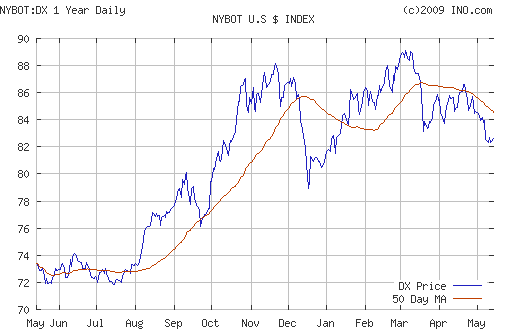
dollar index 1-year-performance

Experts” point to a decline in risk aversion as the chief driver of the rally; when investors become more comfortable with risk, they buy stocks, which in turn causes investors to become even more complacent with risk. Hence, a 30% rally only six months after stocks recorded their worst day and worst week ever.

In this case, however, the experts are not in complete agreement. Economic fundamentals, for example, remain relatively weak, and corporate profits are still anemic. Andy Kessler blames the Fed for distorting “asset allocation formulas” by dropping yields to zero and for its quantitative easing program, which “gets money into the economy the fastest — basically by cranking the handle of the printing press and flooding the market with dollars (in reality, with additional bank credit). Since these dollars are not going into home building, coal-fired electric plants or auto factories, they end up in the stock market.”

Sure enough, trading data suggests that in fact this rally is being driven by retail investors, as opposed to institutions. Says Lou Ritholz, ” ‘The ‘dumb’ retail money is leading the gains. ‘In this type of environment, the market is guilty until proven innocent. We have to assume this remains a bear market until we see a more normalized economy.’ ” In short, it looks like analysts have confused the chicken with egg, by emphasizing the decline in risk aversion, rather than the self-fulfilling nature of the rally.

If the rally does end, it will almost certainly be good news for the Dollar, at least in the short-term. There has emerged a strong correlation between global stock prices and emerging market currencies, for example, which virtually ensures an outflow of capital from emerging markets. One professional idiot- err investor- Jim Rogers has prognosticated an end both to the stock market rally and the Dollar rally. Credit Rogers for his long-term thinking, but he seems to have impugned a direct relationship, when recent trends suggest it is actually inverse.

I agree with Kessler, and abide by the same maxim “Only a fool predicts the stock market…” My point here is not to convince you that the market rally is unsustainable, but rather to emphasize the importance of knowing where you stand. I’m personally quite bearish on the Dollar in the long-term (food for a future post), but a damper in the stock rally would almost certainly be positive for the Dollar.

The Sucker’s Rally and the Dollar

“The Dow Jones Industrial Average has bounced an astounding 30% from its March 9 low of 6547. Is this the dawn of a new era? Are we off to the races again?” Asks Andy Kessler provocatively in a recent Op-Ed for the Wall Street Journal.

This is an important question not only for stock market investors, but also for forex traders. By no coincidence, the stock market rally has coincided with a steady decline in the Dollar, which recently broke through a key level of resistance and touched a four-month low against a basket of currencies, and is similarly nearing a four-month low against its chief rival, the Euro. ”

dollar index 1-year-performance

Experts” point to a decline in risk aversion as the chief driver of the rally; when investors become more comfortable with risk, they buy stocks, which in turn causes investors to become even more complacent with risk. Hence, a 30% rally only six months after stocks recorded their worst day and worst week ever.

In this case, however, the experts are not in complete agreement. Economic fundamentals, for example, remain relatively weak, and corporate profits are still anemic. Andy Kessler blames the Fed for distorting “asset allocation formulas” by dropping yields to zero and for its quantitative easing program, which “gets money into the economy the fastest — basically by cranking the handle of the printing press and flooding the market with dollars (in reality, with additional bank credit). Since these dollars are not going into home building, coal-fired electric plants or auto factories, they end up in the stock market.”

Sure enough, trading data suggests that in fact this rally is being driven by retail investors, as opposed to institutions. Says Lou Ritholz, ” ‘The ‘dumb’ retail money is leading the gains. ‘In this type of environment, the market is guilty until proven innocent. We have to assume this remains a bear market until we see a more normalized economy.’ ” In short, it looks like analysts have confused the chicken with egg, by emphasizing the decline in risk aversion, rather than the self-fulfilling nature of the rally.

If the rally does end, it will almost certainly be good news for the Dollar, at least in the short-term. There has emerged a strong correlation between global stock prices and emerging market currencies, for example, which virtually ensures an outflow of capital from emerging markets. One professional idiot- err investor- Jim Rogers has prognosticated an end both to the stock market rally and the Dollar rally. Credit Rogers for his long-term thinking, but he seems to have impugned a direct relationship, when recent trends suggest it is actually inverse.

I agree with Kessler, and abide by the same maxim “Only a fool predicts the stock market…” My point here is not to convince you that the market rally is unsustainable, but rather to emphasize the importance of knowing where you stand. I’m personally quite bearish on the Dollar in the long-term (food for a future post), but a damper in the stock rally would almost certainly be positive for the Dollar.
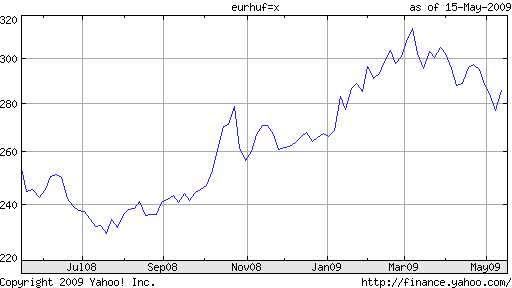
Carry Trade Lifts Hungarian Forint

The rally in emerging markets and accompanying revival of the carry trade can be seen clearly in the Hungarian Forint, which can now claim the distinction of being the world’s best performing currency. You’re probably scratching your head and/or rolling your eyes, but bear with me.

Beginning last July, shortly before the peak of the credit crisis, the Forint began to fall rapidly. It quickly lost more than half of its value against the Dollar, but then again so did a bunch of other currencies. The more relevant comparison is with the Euro, against which the Hungarian currency also fared quite poorly. Despite a 13% rally over the last two months, the Forint is still down 27% from its high last summer.

forint-chart

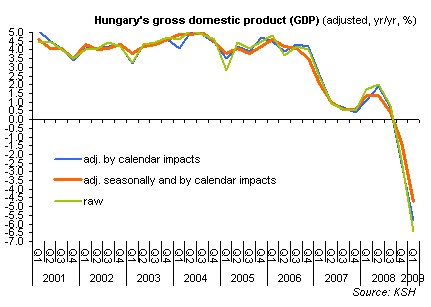
This is understandable, since Hungarian economic fundamenals are commensurately poor. “Household consumption is shrinking due to a drop in wages and narrower borrowing opportunities, while investments are hit by a lack of funds and a global economic downturn.” Factor in an 18.7% annualized decline in exports, and the result is a 6.4% decline in GDP for the most recent quarter.

hungary-2009-gdp

Hungary’s economic woes have not gone unnoticed. “The International Monetary Fund, the EU and the World Bank have pledged 20 billion euros ($27 billion) of emergency loans to support Hungary, the biggest aid package for a European nation alongside Romania.” While financial markets have stabilized, credit default swap rates indicate investors are still concerned about the possibility of default. Meanwhile, Hungary has now been officially rejected (for the second time) by the European Monetary Union, such that its doubtful that Forint will ever be absorbed into the Euro.

Why, then, is the Forint rallying? The answer is simple: high interest rates. The benchmark Hungarian interest rate is a lofty 9.5%. While other Central Banks have been busy lowering rates to try to boost economic growth, “The Monetary Council of the central bank voted unanimously on April 20 to keep rates on hold at 9.50 percent.” Given the precarious financial situation, its economic policymakers are concerned that a drop in interest rates could precipitate capital flight and a currency crisis.

An exasperated Deputy Central Bank Governor explained to reporters, “As long as Hungary is considered such a vulnerable country, our interest rates cannot be lower than South Africa’s or Turkey’s; it’s not the Czech Republic, Slovakia or Poland you should compare us to.” She has clearly been paying monitoring the forex markets and knows that now is not the time to gamble with investors’ sudden return to Hungary.

Analysts remain divided over whether the upward trend in the Forint is sustainable. For its part, “Deutsche Bank recommends investors sell the euro against the forint on bets the rate difference will help the Hungarian currency gain 10 percent to 260 per euro in two to three months from 286.55 today.” However, it will be difficult for the economy to stage a serious economy for as long as the currency is rallying, which is why a survey of analysts revealed a median forecast of a medium-term decline in the Forint

Deflation: Worst-Case Scenario or Already Here?

In following up on last week’s post (”Inflation or Stimulus: An In-depth Look At the Fed’s Response to the Credit Crisis“) on the possibility of inflation, I want to focus today’s post on the opposite phenomenon: deflation.

As evidenced by the huge expansion of government borrowing and Fed Quantitative easing, it is deflation which is currently the paramount concern of policymakers. While falling prices would seem to represent an ideal solution to the current economic downturn, deflation is actually quite pernicious if left unchecked. To elaborate: “When prices fall across the board, businesses and consumers postpone purchases because they expect lower prices later, or worry their incomes will decline or don’t want to acquire assets that will fall in value. Shrinking demand forces sellers to cut prices further, triggering a vicious cycle.” Deflation is also detrimental to consumers with liabilities, which remain the same even as incomes are falling.

Now that we understand what deflation looks like, let’s examine its likelihood. In fact, the current economic environment represents a perfect breeding ground for deflation. For example, both consumers and businesses are using stimulus and bailout checks to pay down debt, rather to increase spending. In addition, businesses are selling out of inventory rather than ramping up production, due to uncertainty for the future. Bond yields are rising, making it more expensive - and hence less likely - for companies to borrow and invest.

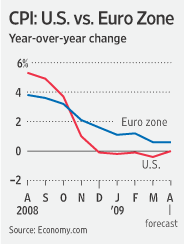
And what about the data? The Retail Price Index, “RPI - which turned negative for the first time in almost 50 years in March - is expected to fall from minus 0.4% to minus 1% in April.” The Consumer Price Index, meanwhile, “declined by 0.7 percent year-over-year in April, the largest 12-month drop since 1955.” It’s hard to take this data seriously, however, given the “seasonal adjustments” and “stripping of so-called volatile energy prices, and using the dubious ” ‘owners equivalent rent,’ OER, to measure consumer housing expenses” in order to conceal the actual decline in property values. In short, the actual decline is probably much worse, especiall given the steep drop in commodities from 2008.

At least Fed Chairman Ben Bernanke is satisfied, and was most recently quoted for his belief that “the risks of deflation were receding.” Bernanke remains committed to pumping money into the economy via its purchases of government bonds. It still has a ways to go in making good on its promise to buy more than $1 Trillion in securities.

While it’s easy to blame the Fed, it’s also hard not to begrudge it some sympathy for having to toe a very thin line between deflation and hyperinflation. In the event that its successful in forestalling a decline in prices, it will have just enough time to catch its breath before drawing all of the new money out of the economy so as to prevent inflation from taking hold and another bubble from forming in asset prices.

cpi-us-vs-euro-zone

US Trade Deficit Nears 10 Year Low; Good News for USD?

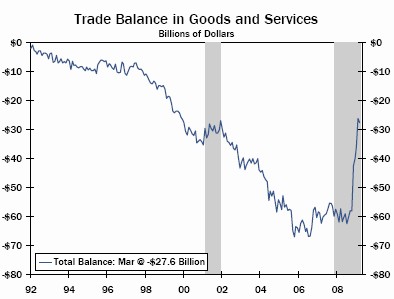
Over the last year, declines in imports and commodity prices have contributed to a veritable collapse in the US trade imbalance. While the deficit increased to $27 Billion last month, the general trend is definitely still downwards.

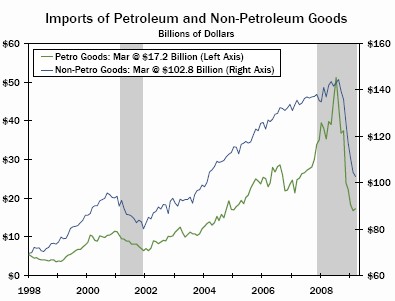
Since the inception of the credit crisis, US imports have fallen by a record 40%, on an annualized basis. In March, “Imports decreased 1 percent to $151.2 billion, the fewest since September 2004. Demand fell for industrial supplies such as natural gas and steel and for capital goods such as engines and machinery, reflecting the slump in U.S. business investment.” Lower commodity prices have also played a role on the imports side of the equation. In fact, if not for a slight uptick in energy prices, the deficit probably would have declined further this month.

imports
Exports are also falling, but at a slower pace, such than the net effect is a more positive US balance of trade. “The 2.4% monthly fall in exports in March more than reversed the 1.5% rise the month before. But even that 2.4% drop compares well with the monthly declines of 6% plus that had become the norm since last September,” explains one economist. In other words, worldwide demand (as symbolized by US exports), is stabilizing.

Economists remain divided as to whether the trade deficit will continue to decline: “The low-hanging fruit has been achieved, and it will be difficult to narrow the trade deficit by much more going forward, especially if the vicious downturn in the economy seen in the fourth quarter and first quarter has begun to abate…..Once the economy begins to return to health in earnest (mainly a 2010 story), the trade deficit will likely begin to re-widen.” But a competing view expects “drooping consumer demand to weigh on imports and keep the trade deficit on a narrowing trend in the coming months,” in which case the deficit could fall to $350 Billion by the end of the year. Compared this to the record $788 Billion deficit of 2006!

While the balance of trade doesn’t figure directly into GDP (although it confusingly is incorporated into the expenditure method), a declining trade balance is generally reflective of a healthier economy. It implies that either exports are growing relatively faster than imports, and/or consumers are diverting more of their relative spending towards domestic consumption, both of which should contribute positively to GDP. Summarizes one economist, “If the current account did move towards balance, then it would allow the U. S. economy to probably grow at a more sustainable rate in the long term.”

The idea of sustainability (not in the environmental sense, unfortunately) is also connected to the US Dollar. Generally speaking, it is the Dollar’s role as the world’s reserve currency which has enabled the US to run a trade imbalance almost continuously for the last 30 years. In other words, trade surplus economies are willing to accept Dollars because they can be stably and profitably invested in the US. In this regard, one commentator hit the nail right on the head: “When it comes to the U.S. trade gap, how many refrigerators the U.S. sells overseas is far less important than how many dollars the rest of the world wants.”

US 2009 trade balance

Note: Both Charts courtesy of International Business Times.

Asian Currencies Rally for Third Straight Month

According to a recent Reuters poll, investors are increasingly bullish on emerging market Asian currencies, including the Taiwan dollar, Indonesian rupiah, Singapore dollar, Malaysian ringgit, Philippine peso, South Korean won, and Indian rupee. The Thai Baht wasn’t covered by the poll, but given its strong performance over the last few months, it seems safe to include it in the bunch.

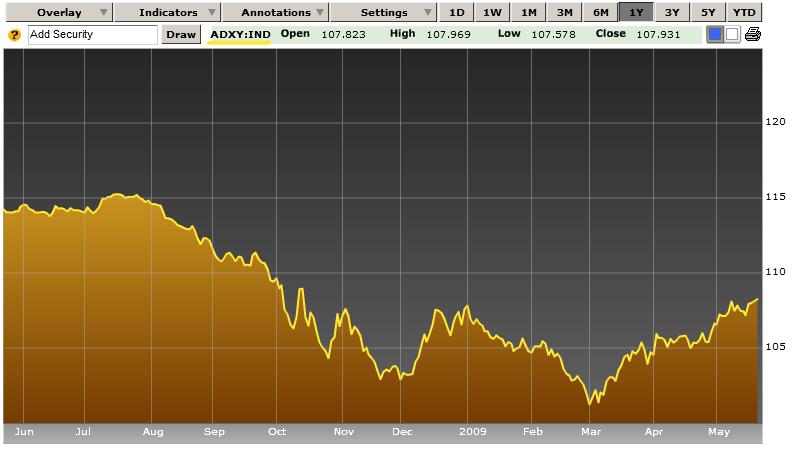
This uptick in sentiment is somewhat unspectacular, since “The Bloomberg-JPMorgan Asia Dollar Index, which tracks the 10 most-active regional currencies,” has now risen for almost three consecutive months [See chart below]. Leading the pack are the Taiwan Dollar and South Korean Won, which recently touched five-month and seven-month highs, respectively. “The Korean currency has climbed 28 percent since reaching an 11-year low of 1,597.45 in March.”

asian-currencies-rise

Investors are now pouring money back into Asia at rapid clip. “Asia ex-Japan received $933 million in the week ended May 20, the most among emerging-market stock funds, bringing the total this year to $6.9 billion.” Meanwhile, the “The MSCI Asia Pacific Index of regional stocks climbed 22 percent this quarter” while Chinese stocks are up 45% since the beginning of 2009.

But it’s unclear - doubtful is a better word - whether this rally is supported by economic fundamentals. One commentator summarized this contradiction as follows: “Improved sentiment has led to a massive resurgence in flows to emerging markets, irrespective of the underlying data, which remains weak. Investors are going out of dollars to riskier markets, riskier currencies.”

Let’s drill down into some of the data. Chinese exports fell 15% in April. Japan’s economy contracted 15% in the most recent quarter. Singapore’s exports are down 20% on an annualized basis. The South Korean economy is projected to shrink by 2% this year. The Central Bank of Thailand just cut its benchmark interest rate to an unbelievable 1%. The only bright spot economically is Taiwan, which is benefiting both from improved economic ties with China and a healthy current account surplus. I suppose everything is relative, as “developing Asian economies will grow 4.8 percent in 2009, even as the world economy contracts 1.3 percent” according to the International Monetary Fund.

The notion that the rally is not rooted in fundamentals is shared by the region’s Central Banks, which clearly realize that economic recovery will be much more difficult in the face of currency appreciation. One analyst argues that, “Until the signs of global economic recovery become more convincing, central banks will unlikely tolerate significant currency appreciation.” The Central Banks of South Korea, Taiwan, and Indonesia have already actively intervened to hold their currencies down, while Malaysia and Singapore (discussed in a Forexblog post last week) have also intervened for the sake of stability.

As a result, this rally could soon begin to lose steam. “A ‘correction’ in regional currencies is ‘appropriate’ following recent gains,” said one analyst. Another has called the rally “overdone.” Still, Central Banks and economic data pale in comparison to capital flows and risk/reward analysis. In short, these currencies (and other investments) will continue to find buyers for as long as there are those hungry for risk. Citigroup, whose “Asia-Pacific foreign-exchange volume may rise about 10 percent from the first quarter,” is bullish. A representative of the firm declared: “Fund managers are still ’sitting on lots and lots of cash’ so the pickup in volumes will continue.”

Outlook is Positive for Australia, but Less so for Australian Dollar


The economic outlook continues to improve for Australia. Most recently, both the government and the Central Bank released five-year growth forecasts, both of which show a modest recovery in 2010. “By 2011-12, the commodity-rich economy will again be firing on all cylinders with growth of 4.5%, well above the long-term growth rate of around 3%.”

This positive development coincided with the release of similarly upbeat economic data: “Retail sales surged 2.2 percent in March from the previous month, four times as much as economists forecast. Home-loan approvals jumped 4.9 percent, the sixth consecutive gain.” Meanwhile, unemployment shrank for the first time in months, and consumer confidence is once again rising. While the economy is forecast to shrink by .75% in the current fiscal year, this compares favorably with other industrialized countries.

The sudden turnaround can be attributed to a couple factors. First of all, the pickup in China’s economy is stimulating demand for natural resources, which had been slack for the last year. If not for simultaneously falling commodity prices, Australia might have even achieved positive economic growth for the year.

The government’s stimulus plan and spending initiatives have also played a role, although the extent cannot be measured accurately for a few months. “The government claims that measures in its budget will inject a further A$8.8 billion into the economy in 2009-10, adding to around A$50 billion in fiscal measures already announced since October 2008.”

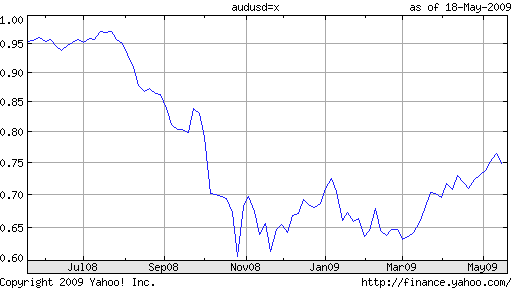
The outlook for the Australian Dollar, meanwhile, is not so rosy. The 425 basis points in cumulative rate cuts that the Royal Bank of Australia (RBA) effected over the last year have lowered the interest rate differential with other industrialized countries. While the RBA has indicated that it will pause before cutting rates further, interest rate futures reflect the expectation that rates will be lower twelve months from now. “Economists say the RBA is open to cutting interest rates again if consumer and business confidence appear threatened, but for now it is content to let monetary and fiscal stimulus measures take hold.”

To be sure, the uptick in risk tolerance has been good for the Australian Dollar, igniting a 25% rise since March. The currency now stands at a 7-month high against the US Dollar. But the increasingly modest differential is now causing some analysts to question whether it is a reasonable risk to take, especially against the backdrop of volatility and a high correlation with global stock prices. “What’s the point of picking up a 3 percent interest-rate differential by being long Aussie and short Japan in a world where the exchange rate can move by that much in two days?” Asks One analyst rhetorically.

This same analyst is actually recommending investors to use the Australian Dollar as a funding currency, and go long on higher-yielding currencies, such as the Brazilian Real. This particular trade would have netted a respectable 5.9% return in 2009. How quickly the roles have reversed!

aud-usd-1-year