Spot
A spot transaction is a two-day delivery transaction (except in the case of trades between the US Dollar, Canadian Dollar, Turkish Lira and Russian Ruble, which settle the next business day), as opposed to the futures contracts, which are usually three months. This trade represents a “direct exchange” between two currencies, has the shortest time frame, involves cash rather than a contract; and interest is not included in the agreed-upon transaction. The data for this study come from the spot market. Spot transactions has the second largest turnover by volume after Swap transactions among all FX transactions in the Global FX market.
One way to deal with the foreign exchange risk is to engage in a forward transaction. In this transaction, money does not actually change hands until some agreed upon future date. A buyer and seller agree on an exchange rate for any date in the future, and the transaction occurs on that date, regardless of what the market rates are then. The duration of the trade can be a one day, a few days, months or years. Usually the date is decided by both parties.
Main article: currency future
Foreign currency futures are exchange traded forward transactions with standard contract sizes and maturity dates — for example, $1000 for next November at an agreed rate [4],[5]. Futures are standardized and are usually traded on an exchange created for this purpose. The average contract length is roughly 3 months. Futures contracts are usually inclusive of any interest amounts.
Main article: foreign exchange swap
The most common type of forward transaction is the currency swap. In a swap, two parties exchange currencies for a certain length of time and agree to reverse the transaction at a later date. These are not standardized contracts and are not traded through an exchange.
Main article: foreign exchange option
A foreign exchange option (commonly shortened to just FX option) is a derivative where the owner has the right but not the obligation to exchange money denominated in one currency into another currency at a pre-agreed exchange rate on a specified date. The FX options market is the deepest, largest and most liquid market for options of any kind in the world.
Exchange-Traded Fund
Main article: exchange-traded fund
Exchange-traded funds (or ETFs) are open ended investment companies that can be traded at any time throughout the course of the day. Typically, ETFs try to replicate a stock market index such as the S&P 500 (e.g., SPY), but recently they are now replicating investments in the currency markets with the ETF increasing in value when the US Dollar weakens versus a specific currency, such as the Euro. Certain of these funds track the price movements of world currencies versus the US Dollar, and increase in value directly counter to the US Dollar, allowing for speculation in the US Dollar for US and US Dollar denominated investors and speculators.
flag counter
u r visitor no.
Thursday, July 16, 2009


References
^ Sullivan, arthur; Steven M. Sheffrin (2003). Economics: Principles in action. Upper Saddle River, New Jersey 07458: Pearson Prentice Hall. pp. 551. ISBN 0-13-063085-3.
^ a b c Triennial Central Bank Survey (December 2007), Bank for International Settlements.
^ a b Annual FX poll (May 2008), Euromoney.
^ BIS Triennial Central Bank Survey, published in December 2007.
^ Source: Euromoney FX survey FX Poll 2008: The Euromoney FX survey is the largest global poll of foreign exchange service providers.'
^ http://www.ifsl.org.uk/upload/CBS_Foreign_Exchange_2007.pdf (December 2007), International Financial Services, London.
^ Alan Greenspan, The Roots of the Mortgage Crisis: Bubbles cannot be safely defused by monetary policy before the speculative fever breaks on its own. , the Wall Street Journal, December 12, 2007
^ McKay, Peter A. (2005-07-26). "Scammers Operating on Periphery Of CFTC's Domain Lure Little Guy With Fantastic Promises of Profits". The Wall Street Journal (Dow Jones and Company). Retrieved on 2007-10-31.
^ Egan, Jack (2005-06-19). "Check the Currency Risk. Then Multiply by 100". The New York Times. Retrieved on 2007-10-30.
^ The Sunday Times (UK), 16 July 2006
^ The 5 largest in the UK are Travelex, Moneycorp, HiFX, World First and Currencies Direct
^ Safe haven currency
^ John J. Murphy, Technical Analysis of the Financial Markets (New York Institute of Finance, 1999), pp. 343–375.
^ Investopedia
^ Sam Y. Cross, All About the Foreign Exchange Market in the United States, Federal Reserve Bank of New York (1998), chapter 11, pp. 113–115.
^ Michael A. S. Guth, "Profitable Destabilizing Speculation," Chapter 1 in Michael A. S. Guth, SPECULATIVE BEHAVIOR AND THE OPERATION OF COMPETITIVE MARKETS UNDER UNCERTAINTY, Avebury Ashgate Publishing, Aldorshot, England (1994), ISBN 1856289850.
^ What I Learned at the World Economic Crisis Joseph Stiglitz, The New Republic, April 17, 2000, reprinted at GlobalPolicy.org
^ Summers LH and Summmers VP (1989) 'When financial markets work too well: a Cautious case for a securities transaction tax' Journal of financial services
^ But Don't Rush Out to Buy Kronor: Sweden's 500% Gamble - International Herald Tribune
^ Gregory J. Millman, Around the World on a Trillion Dollars a Day, Bantam Press, New York, 1995.
^ a b c Triennial Central Bank Survey (December 2007), Bank for International Settlements.
^ a b Annual FX poll (May 2008), Euromoney.
^ BIS Triennial Central Bank Survey, published in December 2007.
^ Source: Euromoney FX survey FX Poll 2008: The Euromoney FX survey is the largest global poll of foreign exchange service providers.'
^ http://www.ifsl.org.uk/upload/CBS_Foreign_Exchange_2007.pdf (December 2007), International Financial Services, London.
^ Alan Greenspan, The Roots of the Mortgage Crisis: Bubbles cannot be safely defused by monetary policy before the speculative fever breaks on its own. , the Wall Street Journal, December 12, 2007
^ McKay, Peter A. (2005-07-26). "Scammers Operating on Periphery Of CFTC's Domain Lure Little Guy With Fantastic Promises of Profits". The Wall Street Journal (Dow Jones and Company). Retrieved on 2007-10-31.
^ Egan, Jack (2005-06-19). "Check the Currency Risk. Then Multiply by 100". The New York Times. Retrieved on 2007-10-30.
^ The Sunday Times (UK), 16 July 2006
^ The 5 largest in the UK are Travelex, Moneycorp, HiFX, World First and Currencies Direct
^ Safe haven currency
^ John J. Murphy, Technical Analysis of the Financial Markets (New York Institute of Finance, 1999), pp. 343–375.
^ Investopedia
^ Sam Y. Cross, All About the Foreign Exchange Market in the United States, Federal Reserve Bank of New York (1998), chapter 11, pp. 113–115.
^ Michael A. S. Guth, "Profitable Destabilizing Speculation," Chapter 1 in Michael A. S. Guth, SPECULATIVE BEHAVIOR AND THE OPERATION OF COMPETITIVE MARKETS UNDER UNCERTAINTY, Avebury Ashgate Publishing, Aldorshot, England (1994), ISBN 1856289850.
^ What I Learned at the World Economic Crisis Joseph Stiglitz, The New Republic, April 17, 2000, reprinted at GlobalPolicy.org
^ Summers LH and Summmers VP (1989) 'When financial markets work too well: a Cautious case for a securities transaction tax' Journal of financial services
^ But Don't Rush Out to Buy Kronor: Sweden's 500% Gamble - International Herald Tribune
^ Gregory J. Millman, Around the World on a Trillion Dollars a Day, Bantam Press, New York, 1995.
Speculation
Controversy about currency speculators and their effect on currency devaluations and national economies recurs regularly. Nevertheless, economists including Milton Friedman have argued that speculators ultimately are a stabilizing influence on the market and perform the important function of providing a market for hedgers and transferring risk from those people who don't wish to bear it, to those who do.[16] Other economists such as Joseph Stiglitz consider this argument to be based more on politics and a free market philosophy than on economics.[17]
Large hedge funds and other well capitalized "position traders" are the main professional speculators. According to some economists, individual traders could act as "noise traders" and have a more destabilizing role than larger and better informed actors [18].
Currency speculation is considered a highly suspect activity in many countries.[where?] While investment in traditional financial instruments like bonds or stocks often is considered to contribute positively to economic growth by providing capital, currency speculation does not; according to this view, it is simply gambling that often interferes with economic policy. For example, in 1992, currency speculation forced the Central Bank of Sweden to raise interest rates for a few days to 500% per annum, and later to devalue the krona.[19] Former Malaysian Prime Minister Mahathir Mohamad is one well known proponent of this view. He blamed the devaluation of the Malaysian ringgit in 1997 on George Soros and other speculators.
Gregory J. Millman reports on an opposing view, comparing speculators to "vigilantes" who simply help "enforce" international agreements and anticipate the effects of basic economic "laws" in order to profit.[20]
In this view, countries may develop unsustainable financial bubbles or otherwise mishandle their national economies, and foreign exchange speculators allegedly made the inevitable collapse happen sooner. A relatively quick collapse might even be preferable to continued economic mishandling. Mahathir Mohamad and other critics of speculation are viewed as trying to deflect the blame from themselves for having caused the unsustainable economic conditions. Given that Malaysia recovered quickly after imposing currency controls directly against IMF advice, this view is open to doubt.
Large hedge funds and other well capitalized "position traders" are the main professional speculators. According to some economists, individual traders could act as "noise traders" and have a more destabilizing role than larger and better informed actors [18].
Currency speculation is considered a highly suspect activity in many countries.[where?] While investment in traditional financial instruments like bonds or stocks often is considered to contribute positively to economic growth by providing capital, currency speculation does not; according to this view, it is simply gambling that often interferes with economic policy. For example, in 1992, currency speculation forced the Central Bank of Sweden to raise interest rates for a few days to 500% per annum, and later to devalue the krona.[19] Former Malaysian Prime Minister Mahathir Mohamad is one well known proponent of this view. He blamed the devaluation of the Malaysian ringgit in 1997 on George Soros and other speculators.
Gregory J. Millman reports on an opposing view, comparing speculators to "vigilantes" who simply help "enforce" international agreements and anticipate the effects of basic economic "laws" in order to profit.[20]
In this view, countries may develop unsustainable financial bubbles or otherwise mishandle their national economies, and foreign exchange speculators allegedly made the inevitable collapse happen sooner. A relatively quick collapse might even be preferable to continued economic mishandling. Mahathir Mohamad and other critics of speculation are viewed as trying to deflect the blame from themselves for having caused the unsustainable economic conditions. Given that Malaysia recovered quickly after imposing currency controls directly against IMF advice, this view is open to doubt.
Market psychology
Market psychology and trader perceptions influence the foreign exchange market in a variety of ways:
Flights to quality
Unsettling international events can lead to a "flight to quality," with investors seeking a "safe haven". There will be a greater demand, thus a higher price, for currencies perceived as stronger over their relatively weaker counterparts. The Swiss franc has been a traditional safe haven during times of political or economic uncertainty.[12]
Long-term trends
Currency markets often move in visible long-term trends. Although currencies do not have an annual growing season like physical commodities, business cycles do make themselves felt. Cycle analysis looks at longer-term price trends that may rise from economic or political trends. [13]
"Buy the rumor, sell the fact"
This market truism can apply to many currency situations. It is the tendency for the price of a currency to reflect the impact of a particular action before it occurs and, when the anticipated event comes to pass, react in exactly the opposite direction. This may also be referred to as a market being "oversold" or "overbought".[14] To buy the rumor or sell the fact can also be an example of the cognitive bias known as anchoring, when investors focus too much on the relevance of outside events to currency prices.
Economic numbers
While economic numbers can certainly reflect economic policy, some reports and numbers take on a talisman-like effect: the number itself becomes important to market psychology and may have an immediate impact on short-term market moves. "What to watch" can change over time. In recent years, for example, money supply, employment, trade balance figures and inflation numbers have all taken turns in the spotlight.
Technical trading considerations
As in other markets, the accumulated price movements in a currency pair such as EUR/USD can form apparent patterns that traders may attempt to use. Many traders study price charts in order to identify such patterns.[15]
Flights to quality
Unsettling international events can lead to a "flight to quality," with investors seeking a "safe haven". There will be a greater demand, thus a higher price, for currencies perceived as stronger over their relatively weaker counterparts. The Swiss franc has been a traditional safe haven during times of political or economic uncertainty.[12]
Long-term trends
Currency markets often move in visible long-term trends. Although currencies do not have an annual growing season like physical commodities, business cycles do make themselves felt. Cycle analysis looks at longer-term price trends that may rise from economic or political trends. [13]
"Buy the rumor, sell the fact"
This market truism can apply to many currency situations. It is the tendency for the price of a currency to reflect the impact of a particular action before it occurs and, when the anticipated event comes to pass, react in exactly the opposite direction. This may also be referred to as a market being "oversold" or "overbought".[14] To buy the rumor or sell the fact can also be an example of the cognitive bias known as anchoring, when investors focus too much on the relevance of outside events to currency prices.
Economic numbers
While economic numbers can certainly reflect economic policy, some reports and numbers take on a talisman-like effect: the number itself becomes important to market psychology and may have an immediate impact on short-term market moves. "What to watch" can change over time. In recent years, for example, money supply, employment, trade balance figures and inflation numbers have all taken turns in the spotlight.
Technical trading considerations
As in other markets, the accumulated price movements in a currency pair such as EUR/USD can form apparent patterns that traders may attempt to use. Many traders study price charts in order to identify such patterns.[15]
Economic factors
These include: (a)economic policy, disseminated by government agencies and central banks, (b)economic conditions, generally revealed through economic reports, and other economic indicators.
Economic policy comprises government fiscal policy (budget/spending practices) and monetary policy (the means by which a government's central bank influences the supply and "cost" of money, which is reflected by the level of interest rates).
Economic conditions include:
Government budget deficits or surpluses
The market usually reacts negatively to widening government budget deficits, and positively to narrowing budget deficits. The impact is reflected in the value of a country's currency.
Balance of trade levels and trends
The trade flow between countries illustrates the demand for goods and services, which in turn indicates demand for a country's currency to conduct trade. Surpluses and deficits in trade of goods and services reflect the competitiveness of a nation's economy. For example, trade deficits may have a negative impact on a nation's currency.
Inflation levels and trends
Typically a currency will lose value if there is a high level of inflation in the country or if inflation levels are perceived to be rising [. This is because inflation erodes purchasing power, thus demand, for that particular currency. However, a currency may sometimes strengthen when inflation rises because of expectations that the central bank will raise short-term interest rates to combat rising inflation.
Economic growth and health
Reports such as GDP, employment levels, retail sales, capacity utilization and others, detail the levels of a country's economic growth and health. Generally, the more healthy and robust a country's economy, the better its currency will perform, and the more demand for it there will be.
Productivity of an economy
Increasing productivity in an economy should positively influence the value of its currency. It affects are more prominent if the increase is in the traded sector [3].
Economic policy comprises government fiscal policy (budget/spending practices) and monetary policy (the means by which a government's central bank influences the supply and "cost" of money, which is reflected by the level of interest rates).
Economic conditions include:
Government budget deficits or surpluses
The market usually reacts negatively to widening government budget deficits, and positively to narrowing budget deficits. The impact is reflected in the value of a country's currency.
Balance of trade levels and trends
The trade flow between countries illustrates the demand for goods and services, which in turn indicates demand for a country's currency to conduct trade. Surpluses and deficits in trade of goods and services reflect the competitiveness of a nation's economy. For example, trade deficits may have a negative impact on a nation's currency.
Inflation levels and trends
Typically a currency will lose value if there is a high level of inflation in the country or if inflation levels are perceived to be rising [. This is because inflation erodes purchasing power, thus demand, for that particular currency. However, a currency may sometimes strengthen when inflation rises because of expectations that the central bank will raise short-term interest rates to combat rising inflation.
Economic growth and health
Reports such as GDP, employment levels, retail sales, capacity utilization and others, detail the levels of a country's economic growth and health. Generally, the more healthy and robust a country's economy, the better its currency will perform, and the more demand for it there will be.
Productivity of an economy
Increasing productivity in an economy should positively influence the value of its currency. It affects are more prominent if the increase is in the traded sector [3].
Determinants of FX Rates
The following theories explain the fluctuations in FX rates in a floating exchange rate regime (In a fixed exchange rate regime, FX rates are decided by its government):
(a) International parity conditions viz; purchasing power parity, interest rate parity, Domestic Fisher effect, International Fisher effect. Though to some extent the above theories provide logical explanation for the fluctuations in exchange rates, yet these theories falter as they are based on challengeable assumptions [e.g., free flow of goods, services and capital] which seldom hold true in the real world.
(b) Balance of payments model (see exchange rate). This model, however, focuses largely on tradable goods and services, ignoring the increasing role of global capital flows. It failed to provide any explanation for continuous appreciation of dollar during 1980s and most part of 1990s in face of soaring US current account deficit.
(c) Asset market model (see exchange rate) views currencies as an important asset class for constructing investment portfolios. Assets prices are influenced mostly by people’s willingness to hold the existing quantities of assets, which in turn depends on their expectations on the future worth of these assets. The asset market model of exchange rate determination states that “the exchange rate between two currencies represents the price that just balances the relative supplies of, and demand for, assets denominated in those currencies.”
None of the models developed so far succeed to explain FX rates levels and volatility in the longer time frames. For shorter time frames (less than a few days) algorithm can be devised to predict prices. Large and small institutions and professional individual traders have made consistent profits from it. It is understood from above models that many macroeconomic factors affect the exchange rates and in the end currency prices are a result of dual forces of demand and supply. The world's currency markets can be viewed as a huge melting pot: in a large and ever-changing mix of current events, supply and demand factors are constantly shifting, and the price of one currency in relation to another shifts accordingly. No other market encompasses (and distills) as much of what is going on in the world at any given time as foreign exchange.
Supply and demand for any given currency, and thus its value, are not influenced by any single element, but rather by several. These elements generally fall into three categories: economic factors, political conditions and market psychology.
(a) International parity conditions viz; purchasing power parity, interest rate parity, Domestic Fisher effect, International Fisher effect. Though to some extent the above theories provide logical explanation for the fluctuations in exchange rates, yet these theories falter as they are based on challengeable assumptions [e.g., free flow of goods, services and capital] which seldom hold true in the real world.
(b) Balance of payments model (see exchange rate). This model, however, focuses largely on tradable goods and services, ignoring the increasing role of global capital flows. It failed to provide any explanation for continuous appreciation of dollar during 1980s and most part of 1990s in face of soaring US current account deficit.
(c) Asset market model (see exchange rate) views currencies as an important asset class for constructing investment portfolios. Assets prices are influenced mostly by people’s willingness to hold the existing quantities of assets, which in turn depends on their expectations on the future worth of these assets. The asset market model of exchange rate determination states that “the exchange rate between two currencies represents the price that just balances the relative supplies of, and demand for, assets denominated in those currencies.”
None of the models developed so far succeed to explain FX rates levels and volatility in the longer time frames. For shorter time frames (less than a few days) algorithm can be devised to predict prices. Large and small institutions and professional individual traders have made consistent profits from it. It is understood from above models that many macroeconomic factors affect the exchange rates and in the end currency prices are a result of dual forces of demand and supply. The world's currency markets can be viewed as a huge melting pot: in a large and ever-changing mix of current events, supply and demand factors are constantly shifting, and the price of one currency in relation to another shifts accordingly. No other market encompasses (and distills) as much of what is going on in the world at any given time as foreign exchange.
Supply and demand for any given currency, and thus its value, are not influenced by any single element, but rather by several. These elements generally fall into three categories: economic factors, political conditions and market psychology.
Money Transfer/Remittance Companies
Money transfer companies/remittance companies perform high-volume low-value transfers generally by economic migrants back to their home country. In 2007, the Aite Group estimated that there were $369 billion of remittances (an increase of 8% on the previous year). The four largest markets (India, China, Mexico and the Philippines) receive $95 billion. The largest and best known provider is Western Union with 345,000 agents globally.
Non-bank Foreign Exchange Companies
Non-bank foreign exchange companies offer currency exchange and international payments to private individuals and companies. These are also known as foreign exchange brokers but are distinct in that they do not offer speculative trading but currency exchange with payments. I.e., there is usually a physical delivery of currency to a bank account.
It is estimated that in the UK, 14% of currency transfers/payments[10] are made via Foreign Exchange Companies.[11] These companies' selling point is usually that they will offer better exchange rates or cheaper payments than the customer's bank. These companies differ from Money Transfer/Remittance Companies in that they generally offer higher-value services.
It is estimated that in the UK, 14% of currency transfers/payments[10] are made via Foreign Exchange Companies.[11] These companies' selling point is usually that they will offer better exchange rates or cheaper payments than the customer's bank. These companies differ from Money Transfer/Remittance Companies in that they generally offer higher-value services.
Retail foreign exchange brokers
There are two types of retail brokers offering the opportunity for speculative trading: retail foreign exchange brokers and market makers. Retail traders (individuals) are a small fraction of this market and may only participate indirectly through brokers or banks. Retail brokers, while largely controlled and regulated by the CFTC and NFA might be subject to foreign exchange scams.[8][9] At present, the NFA and CFTC are imposing stricter requirements, particularly in relation to the amount of Net Capitalization required of its members. As a result many of the smaller, and perhaps questionable brokers are now gone. It is not widely understood that retail brokers and market makers typically trade against their clients and frequently take the other side of their trades. This can often create a potential conflict of interest and give rise to some of the unpleasant experiences some traders have had. A move toward NDD (No Dealing Desk) and STP (Straight Through Processing) has helped to resolve some of these concerns and restore trader confidence, but caution is still advised in ensuring that all is as it is presented.
Investment management firms
Investment management firms (who typically manage large accounts on behalf of customers such as pension funds and endowments) use the foreign exchange market to facilitate transactions in foreign securities. For example, an investment manager bearing an international equity portfolio needs to purchase and sell several pairs of foreign currencies to pay for foreign securities purchases.
Some investment management firms also have more speculative specialist currency overlay operations, which manage clients' currency exposures with the aim of generating profits as well as limiting risk. Whilst the number of this type of specialist firms is quite small, many have a large value of assets under management (AUM), and hence can generate large trades.
Some investment management firms also have more speculative specialist currency overlay operations, which manage clients' currency exposures with the aim of generating profits as well as limiting risk. Whilst the number of this type of specialist firms is quite small, many have a large value of assets under management (AUM), and hence can generate large trades.
Hedge funds as speculators
About 70% to 90% of the foreign exchange transactions are speculative. In other words, the person or institution that bought or sold the currency has no plan to actually take delivery of the currency in the end; rather, they were solely speculating on the movement of that particular currency. Hedge funds have gained a reputation for aggressive currency speculation since 1996. They control billions of dollars of equity and may borrow billions more, and thus may overwhelm intervention by central banks to support almost any currency, if the economic fundamentals are in the hedge funds' favor.
Central banks
National central banks play an important role in the foreign exchange markets. They try to control the money supply, inflation, and/or interest rates and often have official or unofficial target rates for their currencies. They can use their often substantial foreign exchange reserves to stabilize the market. Milton Friedman argued that the best stabilization strategy would be for central banks to buy when the exchange rate is too low, and to sell when the rate is too high—that is, to trade for a profit based on their more precise information. Nevertheless, the effectiveness of central bank "stabilizing speculation" is doubtful because central banks do not go bankrupt if they make large losses, like other traders would, and there is no convincing evidence that they do make a profit trading.
The mere expectation or rumor of central bank intervention might be enough to stabilize a currency, but aggressive intervention might be used several times each year in countries with a dirty float currency regime. Central banks do not always achieve their objectives. The combined resources of the market can easily overwhelm any central bank.[7] Several scenarios of this nature were seen in the 1992–93 ERM collapse, and in more recent times in Southeast Asia.
The mere expectation or rumor of central bank intervention might be enough to stabilize a currency, but aggressive intervention might be used several times each year in countries with a dirty float currency regime. Central banks do not always achieve their objectives. The combined resources of the market can easily overwhelm any central bank.[7] Several scenarios of this nature were seen in the 1992–93 ERM collapse, and in more recent times in Southeast Asia.
Commercial companies
An important part of this market comes from the financial activities of companies seeking foreign exchange to pay for goods or services. Commercial companies often trade fairly small amounts compared to those of banks or speculators, and their trades often have little short term impact on market rates. Nevertheless, trade flows are an important factor in the long-term direction of a currency's exchange rate. Some multinational companies can have an unpredictable impact when very large positions are covered due to exposures that are not widely known by other market participants.
Banks
The interbank market caters for both the majority of commercial turnover and large amounts of speculative trading every day. A large bank may trade billions of dollars daily. Some of this trading is undertaken on behalf of customers, but much is conducted by proprietary desks, trading for the bank's own account. Until recently, foreign exchange brokers did large amounts of business, facilitating interbank trading and matching anonymous counterparts for small fees. Today, however, much of this business has moved on to more efficient electronic systems. The broker squawk box lets traders listen in on ongoing interbank trading and is heard in most trading rooms, but turnover is noticeably smaller than just a few years ago.
Market participants
Unlike a stock market, where all participants have access to the same prices, the foreign exchange market is divided into levels of access. At the top is the inter-bank market, which is made up of the largest investment banking firms. Within the inter-bank market, spreads, which are the difference between the bid and ask prices, are razor sharp and usually unavailable, and not known to players outside the inner circle. The difference between the bid and ask prices widens (from 0-1 pip to 1-2 pips for some currencies such as the EUR). This is due to volume. If a trader can guarantee large numbers of transactions for large amounts, they can demand a smaller difference between the bid and ask price, which is referred to as a better spread. The levels of access that make up the foreign exchange market are determined by the size of the "line" (the amount of money with which they are trading). The top-tier inter-bank market accounts for 53% of all transactions. After that there are usually smaller investment banks, followed by large multi-national corporations (which need to hedge risk and pay employees in different countries), large hedge funds, and even some of the retail FX-metal market makers. According to Galati and Melvin, “Pension funds, insurance companies, mutual funds, and other institutional investors have played an increasingly important role in financial markets in general, and in FX markets in particular, since the early 2000s.” (2004) In addition, he notes, “Hedge funds have grown markedly over the 2001–2004 period in terms of both number and overall size” Central banks also participate in the foreign exchange market to align currencies to their economic needs.
Market size and liquidity
Presently, the foreign exchange market is one of the largest and most liquid financial markets in the world. Traders include large banks, central banks, currency speculators, corporations, governments, and other financial institutions. The average daily volume in the global foreign exchange and related markets is continuously growing. Daily turnover was reported to be over US$3.2 trillion in April 2007 by the Bank for International Settlements. [2] Since then, the market has continued to grow. According to Euromoney's annual FX Poll, volumes grew a further 41% between 2007 and 2008.[3]
Of the $3.98 trillion daily global turnover, trading in London accounted for around $1.36 trillion, or 34.1% of the total, making London by far the global center for foreign exchange. In second and third places respectively, trading in New York accounted for 16.6%, and Tokyo accounted for 6.0%.[4] In addition to "traditional" turnover, $2.1 trillion was traded in derivatives.
Exchange-traded FX futures contracts were introduced in 1972 at the Chicago Mercantile Exchange and are actively traded relative to most other futures contracts.
Several other developed countries also permit the trading of FX derivative products (like currency futures and options on currency futures) on their exchanges. All these developed countries already have fully convertible capital accounts. Most emerging countries do not permit FX derivative products on their exchanges in view of prevalent controls on the capital accounts. However, a few select emerging countries (e.g., Korea, South Africa, India—[1]; [2]) have already successfully experimented with the currency futures exchanges, despite having some controls on the capital account.
FX futures volume has grown rapidly in recent years, and accounts for about 7% of the total foreign exchange market volume, according to The Wall Street Journal Europe (5/5/06, p. 20).
Top 10 currency traders [5]
% of overall volume, May 2008
Rank Name Volume
1 Deutsche Bank 21.70%
2 UBS AG 15.80%
3 Barclays Capital 9.12%
4 Citi 7.49%
5 Royal Bank of Scotland 7.30%
6 JPMorgan 4.19%
7 HSBC 4.10%
8 Lehman Brothers 3.58%
9 Goldman Sachs 3.47%
10 Morgan Stanley 2.86%
Foreign exchange trading increased by 38% between April 2005 and April 2006 and has more than doubled since 2001. This is largely due to the growing importance of foreign exchange as an asset class and an increase in fund management assets, particularly of hedge funds and pension funds. The diverse selection of execution venues have made it easier for retail traders to trade in the foreign exchange market. In 2006, retail traders constituted over 2% of the whole FX market volumes with an average daily trade volume of over US$50-60 billion (see retail trading platforms).[6] Because foreign exchange is an OTC market where brokers/dealers negotiate directly with one another, there is no central exchange or clearing house. The biggest geographic trading centre is the UK, primarily London, which according to IFSL estimates has increased its share of global turnover in traditional transactions from 31.3% in April 2004 to 34.1% in April 2007. The ten most active traders account for almost 80% of trading volume, according to the 2008 Euromoney FX survey.[3] These large international banks continually provide the market with both bid (buy) and ask (sell) prices. The bid/ask spread is the difference between the price at which a bank or market maker will sell ("ask", or "offer") and the price at which a market-maker will buy ("bid") from a wholesale customer. This spread is minimal for actively traded pairs of currencies, usually 0–3 pips. For example, the bid/ask quote of EUR/USD might be 1.2200/1.2203 on a retail broker. Minimum trading size for most deals is usually 100,000 units of base currency, which is a standard "lot".
These spreads might not apply to retail customers at banks, which will routinely mark up the difference to say 1.2100/1.2300 for transfers, or say 1.2000/1.2400 for banknotes or travelers' checks. Spot prices at market makers vary, but on EUR/USD are usually no more than 3 pips wide (i.e., 0.0003). Competition is greatly increased with larger transactions, and pip spreads shrink on the major pairs to as little as 1 to 2 pips.
Of the $3.98 trillion daily global turnover, trading in London accounted for around $1.36 trillion, or 34.1% of the total, making London by far the global center for foreign exchange. In second and third places respectively, trading in New York accounted for 16.6%, and Tokyo accounted for 6.0%.[4] In addition to "traditional" turnover, $2.1 trillion was traded in derivatives.
Exchange-traded FX futures contracts were introduced in 1972 at the Chicago Mercantile Exchange and are actively traded relative to most other futures contracts.
Several other developed countries also permit the trading of FX derivative products (like currency futures and options on currency futures) on their exchanges. All these developed countries already have fully convertible capital accounts. Most emerging countries do not permit FX derivative products on their exchanges in view of prevalent controls on the capital accounts. However, a few select emerging countries (e.g., Korea, South Africa, India—[1]; [2]) have already successfully experimented with the currency futures exchanges, despite having some controls on the capital account.
FX futures volume has grown rapidly in recent years, and accounts for about 7% of the total foreign exchange market volume, according to The Wall Street Journal Europe (5/5/06, p. 20).
Top 10 currency traders [5]
% of overall volume, May 2008
Rank Name Volume
1 Deutsche Bank 21.70%
2 UBS AG 15.80%
3 Barclays Capital 9.12%
4 Citi 7.49%
5 Royal Bank of Scotland 7.30%
6 JPMorgan 4.19%
7 HSBC 4.10%
8 Lehman Brothers 3.58%
9 Goldman Sachs 3.47%
10 Morgan Stanley 2.86%
Foreign exchange trading increased by 38% between April 2005 and April 2006 and has more than doubled since 2001. This is largely due to the growing importance of foreign exchange as an asset class and an increase in fund management assets, particularly of hedge funds and pension funds. The diverse selection of execution venues have made it easier for retail traders to trade in the foreign exchange market. In 2006, retail traders constituted over 2% of the whole FX market volumes with an average daily trade volume of over US$50-60 billion (see retail trading platforms).[6] Because foreign exchange is an OTC market where brokers/dealers negotiate directly with one another, there is no central exchange or clearing house. The biggest geographic trading centre is the UK, primarily London, which according to IFSL estimates has increased its share of global turnover in traditional transactions from 31.3% in April 2004 to 34.1% in April 2007. The ten most active traders account for almost 80% of trading volume, according to the 2008 Euromoney FX survey.[3] These large international banks continually provide the market with both bid (buy) and ask (sell) prices. The bid/ask spread is the difference between the price at which a bank or market maker will sell ("ask", or "offer") and the price at which a market-maker will buy ("bid") from a wholesale customer. This spread is minimal for actively traded pairs of currencies, usually 0–3 pips. For example, the bid/ask quote of EUR/USD might be 1.2200/1.2203 on a retail broker. Minimum trading size for most deals is usually 100,000 units of base currency, which is a standard "lot".
These spreads might not apply to retail customers at banks, which will routinely mark up the difference to say 1.2100/1.2300 for transfers, or say 1.2000/1.2400 for banknotes or travelers' checks. Spot prices at market makers vary, but on EUR/USD are usually no more than 3 pips wide (i.e., 0.0003). Competition is greatly increased with larger transactions, and pip spreads shrink on the major pairs to as little as 1 to 2 pips.
The 1970's United States Currency Policy Meltdown
Once again, we are hit with the triumvirate of war, the restrictive gold standard, and dollars in foreign banks.
This time, each problem was feeding directly off of the others. The Vietnam Conflict had drained our gold reserves heavily. By 1970, Fort Knox only held US$12 Billion.
The growth of the oil business and the increase in foreign trade caused a boom in the demand for US dollars in foreign banks. Over US$ 47 Billion was sitting in overseas banks.
On paper, our gold reserves were over-leveraged by almost 4 to 1. As a nation, we did not know how to react to such an overbearing assault on our currency. Then along came the invention of the Eurodollar to make our nightmare worse.
Foreign banks with US dollars would make low-interest loans in US dollars to importers and exporters. Although the dollars were never repatriated, the US was still on the hook to exchange these “credit”-created dollars for the gold we kept on reserve.
Then came a miracle in disguise . The Bretton Woods Agreement collapsed. In the over-leveraged gold-dollar environment, many countries began to feel frustrated with the artificial peg.
In blatant defiance to the agreement in 1971, Germany declared that they would float the Deutsche mark. They were tired of the artificial peg that was keeping their economy depressed.
In the first hour of trading, over US$1 billion were exchanged for Deutsche marks. For the first time, the public had voiced their opinion against being so heavily weighted with dollars.
With Germany completely ignoring the Bretton Woods Agreement by floating their currency, the US government had nothing left to do but put the final nail in the coffin of the U.S.'s currency policy. The Bretton Woods Agreement was dissolved.
Three short months after the Deutsche mark began to float, the US moved off of the gold standard. Gold was allowed to float freely like any other currency. Oil, although priced in US dollars, soon switched to a peg against gold. Gold and oil prices jumped ten-fold.
The currency dynamics were soon changed on a global scale and it became accepted practice that countries began to float their own currency.
This time, each problem was feeding directly off of the others. The Vietnam Conflict had drained our gold reserves heavily. By 1970, Fort Knox only held US$12 Billion.
The growth of the oil business and the increase in foreign trade caused a boom in the demand for US dollars in foreign banks. Over US$ 47 Billion was sitting in overseas banks.
On paper, our gold reserves were over-leveraged by almost 4 to 1. As a nation, we did not know how to react to such an overbearing assault on our currency. Then along came the invention of the Eurodollar to make our nightmare worse.
Foreign banks with US dollars would make low-interest loans in US dollars to importers and exporters. Although the dollars were never repatriated, the US was still on the hook to exchange these “credit”-created dollars for the gold we kept on reserve.
Then came a miracle in disguise . The Bretton Woods Agreement collapsed. In the over-leveraged gold-dollar environment, many countries began to feel frustrated with the artificial peg.
In blatant defiance to the agreement in 1971, Germany declared that they would float the Deutsche mark. They were tired of the artificial peg that was keeping their economy depressed.
In the first hour of trading, over US$1 billion were exchanged for Deutsche marks. For the first time, the public had voiced their opinion against being so heavily weighted with dollars.
With Germany completely ignoring the Bretton Woods Agreement by floating their currency, the US government had nothing left to do but put the final nail in the coffin of the U.S.'s currency policy. The Bretton Woods Agreement was dissolved.
Three short months after the Deutsche mark began to float, the US moved off of the gold standard. Gold was allowed to float freely like any other currency. Oil, although priced in US dollars, soon switched to a peg against gold. Gold and oil prices jumped ten-fold.
The currency dynamics were soon changed on a global scale and it became accepted practice that countries began to float their own currency.
New Rules of Currency
In 1971, the Smithsonian Agreement replaced the Bretton Woods Agreement and authorized “forward currency contracts”, adding validity to the Eurodollar phenomenon. It didn’t work. A year later the European Joint Float was established. It, and the Smithsonian Agreement, were scrapped in 1973. Even though they were dissolved the concept of “forward currency contracts” stayed as part of the banking system.
Once currencies began to “free-float”, they immediately moved away from their gentlemanly 1% fluctuations on either side to huge price ranges, going anywhere from 20-25% daily.
From 1970-1973, the total foreign exchange volume went from US$25 Billion to US$100 Billion. With oil prices up, gold prices up, and an economy still reeling from the rapid currency shift, “stagflation”, rising inflation while real incomes remained the same, soon hit the United States.
Once currencies began to “free-float”, they immediately moved away from their gentlemanly 1% fluctuations on either side to huge price ranges, going anywhere from 20-25% daily.
From 1970-1973, the total foreign exchange volume went from US$25 Billion to US$100 Billion. With oil prices up, gold prices up, and an economy still reeling from the rapid currency shift, “stagflation”, rising inflation while real incomes remained the same, soon hit the United States.
Today's Currency World
In the 30 years since the collapse of the last gentlemanly agreement on currency rates, many momentous events have occurred that have affected currencies worldwide. The Japanese yen gained prominence because of Japan's heavy export relationship with the United States. The USSR collapsed. We have had several undeclared wars, the south Asian economies have risen and collapsed, and several investor bubbles have come and gone.
Each time, currencies have come away with a newly earned respect by the masses. There has also been a constant element of surprise that keeps you guessing what's next.
Current conditions, such as the United States' perpetual war on “terror”, the permanent introduction and dominance of the euro currency, the steady O.P.E.C. increases in oil prices, and gold's renaissance as a store of value, will likely have a tremendous impact on the future of what it means to trade currencies.
This could be a fundamental shift in the next phase of currency d
Each time, currencies have come away with a newly earned respect by the masses. There has also been a constant element of surprise that keeps you guessing what's next.
Current conditions, such as the United States' perpetual war on “terror”, the permanent introduction and dominance of the euro currency, the steady O.P.E.C. increases in oil prices, and gold's renaissance as a store of value, will likely have a tremendous impact on the future of what it means to trade currencies.
This could be a fundamental shift in the next phase of currency d
Earn money from MintMoney a popular network
I just tried a very popular network called YouMint and it looks amazing!
1. Invite Friends and get them to invite theirs. Mint Money! (Rs. 110 for 20 friends)
2. Choose to receive relevant SMS Promos. Mint even more money! (Approx Rs. 650 a month)
3. Send Free SMS to anyone in India!
4. Its fun find out unlimited free wallpapers and pictures messages for your mobile phone
YouMint is backed by international investors of great fame and the same guys who started the mobile short code revolution in India!
Check it out...www. youmint. com/network-dio123
1. Invite Friends and get them to invite theirs. Mint Money! (Rs. 110 for 20 friends)
2. Choose to receive relevant SMS Promos. Mint even more money! (Approx Rs. 650 a month)
3. Send Free SMS to anyone in India!
4. Its fun find out unlimited free wallpapers and pictures messages for your mobile phone
YouMint is backed by international investors of great fame and the same guys who started the mobile short code revolution in India!
Check it out...www. youmint. com/network-dio123
HOW ALEXA COMPUTES PR TO A WEBSITE OR BLOG
Alexa computes traffic rankings by analyzing the Web usage of millions of Alexa Toolbar users. The information is sorted, sifted, anonymized, counted, and computed, until, finally, we get the traffic rankings shown in the Alexa service. The process is relatively complex, but if you have a need to know, please read on.
What is Traffic Rank?
The traffic rank is based on three months of aggregated historical traffic data from millions of Alexa Toolbar users and is a combined measure of page views and users (reach). As a first step, Alexa computes the reach and number of page views for all sites on the Web on a daily basis. The main Alexa traffic rank is based on the geometric mean of these two quantities averaged over time (so that the rank of a site reflects both the number of users who visit that site as well as the number of pages on the site viewed by those users). The three-month change is determined by comparing the site's current rank with its rank from three months ago. For example, on July 1, the three-month change would show the difference between the rank based on traffic during the first quarter of the year and the rank based on traffic during the second quarter.
What are sites and Web hosts?
Traffic is computed for sites, which are typically defined at the domain level. For example, the Web hosts www.msn.com, carpoint.msn.com and slate.msn.com are all treated as part of the same site, because they all reside on the same domain, msn.com. An exception is blogs or personal home pages, which are treated separately if they can be automatically identified as such from the URLs in question. Also, sites which are found to be serving the "same" content are generally counted together as the same site.
What is Reach?
Reach measures the number of users. Reach is typically expressed as the percentage of all Internet users who visit a given site. So, for example, if a site like yahoo.com has a reach of 28%, this means that of all global Internet users measured by Alexa, 28% of them visit yahoo.com. Alexa's one-week and three-month average reach are measures of daily reach, averaged over the specified time period. The three-month change is determined by comparing a site's current reach with its values from three months ago.
What are Page Views?
Page views measure the number of pages viewed by Alexa Toolbar users. Multiple page views of the same page made by the same user on the same day are counted only once. The page views per user numbers are the average numbers of unique pages viewed per user per day by the users visiting the site. The three-month change is determined by comparing a site's current page view numbers with those from three month ago.
How Are Traffic Trend Graphs Calculated?
The Trend graph shows you a three-day moving average of the site's daily traffic rank, charted over time. The daily traffic rank reflects the traffic to the site based on data for a single day. In contrast, the main traffic rank shown in the Alexa Toolbar and elsewhere in the service is calculated from three months of aggregate traffic data.
Daily traffic rankings will sometimes benefit sites with sporadically high traffic, while the three-month traffic ranking benefits sites with consistent traffic over time. Since we feel that consistent traffic is a better indication of a site's value, we've chosen to use the three-month traffic rank to represent the site's overall popularity. We use the daily traffic rank in the Trend graphs because it allows you to see short-term fluctuations in traffic much more clearly.
It is possible for a site's three-month traffic rank to be higher than any single daily rank shown in the Trend graph. On any given day there may be many sites that temporarily shoot up in the rankings. But if a site has consistent traffic performance, it may end up with the best ranking when the traffic data are aggregated into the three-month average. A good analogy is a four-day golf tournament: if a different player comes in first at each match, but you come in second at all four matches, you can end up winning the tournament.
How are Movers & Shakers Calculated?
The movers and shakers list is based on changes in average reach (numbers of users). For each site on the net, we compute the average weekly reach and compare it with the average reach during previous weeks. The more significant the change, the higher the site will be on the list. The percent change shown on the Movers & Shakers list is based on the change in reach. It is important to note that the traffic rankings shown on the Movers & Shakers page are weekly traffic rankings; they are not the same as the three-month average traffic rankings shown in the other Alexa services and are not the same as the reach numbers used to generate the list.
What is Traffic Rank?
The traffic rank is based on three months of aggregated historical traffic data from millions of Alexa Toolbar users and is a combined measure of page views and users (reach). As a first step, Alexa computes the reach and number of page views for all sites on the Web on a daily basis. The main Alexa traffic rank is based on the geometric mean of these two quantities averaged over time (so that the rank of a site reflects both the number of users who visit that site as well as the number of pages on the site viewed by those users). The three-month change is determined by comparing the site's current rank with its rank from three months ago. For example, on July 1, the three-month change would show the difference between the rank based on traffic during the first quarter of the year and the rank based on traffic during the second quarter.
What are sites and Web hosts?
Traffic is computed for sites, which are typically defined at the domain level. For example, the Web hosts www.msn.com, carpoint.msn.com and slate.msn.com are all treated as part of the same site, because they all reside on the same domain, msn.com. An exception is blogs or personal home pages, which are treated separately if they can be automatically identified as such from the URLs in question. Also, sites which are found to be serving the "same" content are generally counted together as the same site.
What is Reach?
Reach measures the number of users. Reach is typically expressed as the percentage of all Internet users who visit a given site. So, for example, if a site like yahoo.com has a reach of 28%, this means that of all global Internet users measured by Alexa, 28% of them visit yahoo.com. Alexa's one-week and three-month average reach are measures of daily reach, averaged over the specified time period. The three-month change is determined by comparing a site's current reach with its values from three months ago.
What are Page Views?
Page views measure the number of pages viewed by Alexa Toolbar users. Multiple page views of the same page made by the same user on the same day are counted only once. The page views per user numbers are the average numbers of unique pages viewed per user per day by the users visiting the site. The three-month change is determined by comparing a site's current page view numbers with those from three month ago.
How Are Traffic Trend Graphs Calculated?
The Trend graph shows you a three-day moving average of the site's daily traffic rank, charted over time. The daily traffic rank reflects the traffic to the site based on data for a single day. In contrast, the main traffic rank shown in the Alexa Toolbar and elsewhere in the service is calculated from three months of aggregate traffic data.
Daily traffic rankings will sometimes benefit sites with sporadically high traffic, while the three-month traffic ranking benefits sites with consistent traffic over time. Since we feel that consistent traffic is a better indication of a site's value, we've chosen to use the three-month traffic rank to represent the site's overall popularity. We use the daily traffic rank in the Trend graphs because it allows you to see short-term fluctuations in traffic much more clearly.
It is possible for a site's three-month traffic rank to be higher than any single daily rank shown in the Trend graph. On any given day there may be many sites that temporarily shoot up in the rankings. But if a site has consistent traffic performance, it may end up with the best ranking when the traffic data are aggregated into the three-month average. A good analogy is a four-day golf tournament: if a different player comes in first at each match, but you come in second at all four matches, you can end up winning the tournament.
How are Movers & Shakers Calculated?
The movers and shakers list is based on changes in average reach (numbers of users). For each site on the net, we compute the average weekly reach and compare it with the average reach during previous weeks. The more significant the change, the higher the site will be on the list. The percent change shown on the Movers & Shakers list is based on the change in reach. It is important to note that the traffic rankings shown on the Movers & Shakers page are weekly traffic rankings; they are not the same as the three-month average traffic rankings shown in the other Alexa services and are not the same as the reach numbers used to generate the list.
ATTRACT VISITORS TO YOUR BLOG OR WEBSITE
TOO MANY WEB MARKETERS work on the if-you-build-it-they-will-come model. They won't. Once you build a Web site you must give them a reason to come. A Web site is a passive form of marketing: providing a signboard which points visitors to your products and services. To be most effective, a Web site should be used in conjunction with seven active forms of marketing which we will examine briefly in this article. Just how do small business people on a limited budget entice visitors to their Web site?
First, advertise your Web site to Web search engines that index the Web, such as Yahoo, Lycos, WebCrawler, and InfoSeek. The actual registration process can be deceptively simple. A service called SubmitIt! (http://www.submit-it.com) provides a way to submit information to approximately 15 of the most important indexes. If you do this late at night when Internet traffic is at its lowest, you can transmit your business's on-line address and description to all of these within three-quarters of an hour. Done right, a person who is seeking a consulting engineer in Northern California with experience in large electrical systems will quickly locate your name. Widget customers will be able to pick you out from the increasing crowd of on-line vendors.
The danger is that the untutored can construct a carelessly-written 25-word or 200-character marketing description that blows their opportunity to be seen by vast blocks of potential customers. These 25 words must be written to include the chief keywords by which customers would locate you. If you want to change your description in a month or two, it takes much longer than an hour to contact each of the services separately, and then convince or nag them into making changes.
You can pay modest amounts to several services to perform this important task for you. For example, my company, Wilson Internet Services, offers as part of our website packages to carefully register your Web site with the most important indexes.
2. Second, you must give them a good reason to come. A tried-and-true marketing approach is to offer something of value for free. A number of well-financed corporate Web sites offer an entertaining fare which changes constantly. While most small business Web marketers can't afford to compete, you can afford to offer valuable information. If you take the time to provide up-to-date information about your industry, for example, you'll find people returning again and again to your site, each time increasing their chances of doing business with you.
3. A third approach is to find industry-wide linking pages and negotiate reciprocal links to and from their Web pages. Your trade association probably lists members. Several on-line craft centers, for example, offer free links to other crafters. If you are a hotel, be sure to get a link with "All the Hotels on the Web" Consultants will seek links with The Expert Marketplace, or try for a listing in the Virtual Trade Show. The entire list can seem endless, but specific for each industry. Surf the net enough to find which are the key sites for your field, and then seek links there.
4. A fourth method is to purchase Web advertising--usually a rectangle ad with a clickable link to your site on a carefully-selected, high-volume Web site. A certain percentage of their thousands of visitors will explore you Web site, and hopefully like what they find. A whole industry has sprung up to act as brokers for such ads .Small business people will need to find ways to test the effect of specific ads on the bottom line, perhaps by sending people from each ad to a different Web page "front door" so you can monitor traffic from each ad.
5. A fifth important way to let people know about your Web site is to become active in several of the thousands of Internet news groups and mailing lists. Find the groups that are most likely to be frequented by your potential customers--groups can be very narrowly targeted--and join in the discussion. You might find groups that relate to your industry by doing a bit of research with DejaNews (http://www.dejanews.com), which searches messages about particular topics or companies voiced in thousands of news groups and mailing lists.
"Lurk" for a few weeks so you understand the particular culture of the group you are targeting. Then find ways to add constructive comments to the discussion. At the bottom of each message include a "signature"--a 4- to 8-line mini-advertisement with your product, phone number, and Web address. Every time you contribute to the discussion, your mini-ad is seen by hundreds. You'll find considerable fruit this way, but like anything, it comes in response to hard work and persistence. Resist the temptation to send bulk e-mail messages to dozens of news groups--"spamming" in Internet parlance. People do it, but while it may bring customers, it doesn't offer the solid reputation and respect which will build your business in the long run.
6. Sixth, make your Web site part of one or more of the many "malls." Businesses in physical shopping malls benefit from the traffic flow of multitudes window shopping. The same can be true on-line.
Some malls only include businesses who subscribe to a particular Internet Service Provider (ISP) or pay a fee or percentage of their gross revenues. Others take any business that fits their particular criteria. Dave Taylor, for example, developed The Internet Mall (http://www.internet-mall.com/), a collection of upwards of 30,000+ businesses that meet under one roof. The mall is illusory, however, since businesses in the mall are hosted on separate ISP sites all over the world. Perhaps the largest mall, if you will, is Yahoo (http://www.yahoo.com), which doesn't charge anything, but gets its revenues through advertising. Make sure you have a good link there.
7. Finally, include your e-mail and Web addresses on all your company's print literature, stationery, and display advertising. If people believe they can find out more about your products or services by looking on-line, many will do so.
There you have it, seven important ways to increase traffic to your company's Web site. If you use most or all of these forms of marketing, the chances are that two years from now you'll be bragging about your foresight in developing a Web site when you did, rather than trashing Web marketing as just another fad where you threw good money after bad.
First, advertise your Web site to Web search engines that index the Web, such as Yahoo, Lycos, WebCrawler, and InfoSeek. The actual registration process can be deceptively simple. A service called SubmitIt! (http://www.submit-it.com) provides a way to submit information to approximately 15 of the most important indexes. If you do this late at night when Internet traffic is at its lowest, you can transmit your business's on-line address and description to all of these within three-quarters of an hour. Done right, a person who is seeking a consulting engineer in Northern California with experience in large electrical systems will quickly locate your name. Widget customers will be able to pick you out from the increasing crowd of on-line vendors.
The danger is that the untutored can construct a carelessly-written 25-word or 200-character marketing description that blows their opportunity to be seen by vast blocks of potential customers. These 25 words must be written to include the chief keywords by which customers would locate you. If you want to change your description in a month or two, it takes much longer than an hour to contact each of the services separately, and then convince or nag them into making changes.
You can pay modest amounts to several services to perform this important task for you. For example, my company, Wilson Internet Services, offers as part of our website packages to carefully register your Web site with the most important indexes.
2. Second, you must give them a good reason to come. A tried-and-true marketing approach is to offer something of value for free. A number of well-financed corporate Web sites offer an entertaining fare which changes constantly. While most small business Web marketers can't afford to compete, you can afford to offer valuable information. If you take the time to provide up-to-date information about your industry, for example, you'll find people returning again and again to your site, each time increasing their chances of doing business with you.
3. A third approach is to find industry-wide linking pages and negotiate reciprocal links to and from their Web pages. Your trade association probably lists members. Several on-line craft centers, for example, offer free links to other crafters. If you are a hotel, be sure to get a link with "All the Hotels on the Web" Consultants will seek links with The Expert Marketplace, or try for a listing in the Virtual Trade Show. The entire list can seem endless, but specific for each industry. Surf the net enough to find which are the key sites for your field, and then seek links there.
4. A fourth method is to purchase Web advertising--usually a rectangle ad with a clickable link to your site on a carefully-selected, high-volume Web site. A certain percentage of their thousands of visitors will explore you Web site, and hopefully like what they find. A whole industry has sprung up to act as brokers for such ads .Small business people will need to find ways to test the effect of specific ads on the bottom line, perhaps by sending people from each ad to a different Web page "front door" so you can monitor traffic from each ad.
5. A fifth important way to let people know about your Web site is to become active in several of the thousands of Internet news groups and mailing lists. Find the groups that are most likely to be frequented by your potential customers--groups can be very narrowly targeted--and join in the discussion. You might find groups that relate to your industry by doing a bit of research with DejaNews (http://www.dejanews.com), which searches messages about particular topics or companies voiced in thousands of news groups and mailing lists.
"Lurk" for a few weeks so you understand the particular culture of the group you are targeting. Then find ways to add constructive comments to the discussion. At the bottom of each message include a "signature"--a 4- to 8-line mini-advertisement with your product, phone number, and Web address. Every time you contribute to the discussion, your mini-ad is seen by hundreds. You'll find considerable fruit this way, but like anything, it comes in response to hard work and persistence. Resist the temptation to send bulk e-mail messages to dozens of news groups--"spamming" in Internet parlance. People do it, but while it may bring customers, it doesn't offer the solid reputation and respect which will build your business in the long run.
6. Sixth, make your Web site part of one or more of the many "malls." Businesses in physical shopping malls benefit from the traffic flow of multitudes window shopping. The same can be true on-line.
Some malls only include businesses who subscribe to a particular Internet Service Provider (ISP) or pay a fee or percentage of their gross revenues. Others take any business that fits their particular criteria. Dave Taylor, for example, developed The Internet Mall (http://www.internet-mall.com/), a collection of upwards of 30,000+ businesses that meet under one roof. The mall is illusory, however, since businesses in the mall are hosted on separate ISP sites all over the world. Perhaps the largest mall, if you will, is Yahoo (http://www.yahoo.com), which doesn't charge anything, but gets its revenues through advertising. Make sure you have a good link there.
7. Finally, include your e-mail and Web addresses on all your company's print literature, stationery, and display advertising. If people believe they can find out more about your products or services by looking on-line, many will do so.
There you have it, seven important ways to increase traffic to your company's Web site. If you use most or all of these forms of marketing, the chances are that two years from now you'll be bragging about your foresight in developing a Web site when you did, rather than trashing Web marketing as just another fad where you threw good money after bad.
Don’t Fall Into Traps When Looking To Make Money Online
It can be very rewarding getting involved in internet marketing and starting your own online business, but one must be careful not to fall into some of the inherent traps that come with starting out working on the internet. There are plenty of people out there that design programs to target beginners and take their money. It is very real that fortunes can be made on the internet but care must be taken to identify these scams and steer clear. Only when one has found a suitable program with the support required that one can start to make money online.
The number of people looking for ways to earn extra money online has increased dramatically and so has the number of clever people looking at ways to scam them. If you entered a key phrase into the search engines relating to working from home you will be presented with millions of businesses offering their services or products that will make you rich. It is difficult to find the legitimate ones out of all the scammers. Dont fall into the trap of thinking that you can get rich overnight like many of these businesses claim they can do for you. People do make money on the internet and lots of it, but overnight successes stories are far and few between these sorts of programs should be avoided. Never part with your bank details unless you are 100% sure that the website is genuine and secure, it is not unheard of for these people to loot your bank account and vanish from the web never to be seen again.
Identify scammers
The program must tell you exactly how you will be able to make money on their program. It is important to understand exactly what you will do or how will you make money prior to make commitment. Scam websites will just keep on telling how much money you will earn. But the details of how the process would be are missing since they themselves dont really know how they could earn that much money in a certain period of time. In addition, a legitimate money making program should offer you training program to help you get on the right track. If you are dealing with a money making program which do not offer training, it is better to move to the next program.
A genuine money making business should have no problems with providing you with contact information, in fact a genuine business will be bending over backwards to contact you. You should look for an email address that is immediately associated with the company in question, (ex.name@companywebsite.com) also one should be looking for telephone numbers and an address. Testing the telephone number is a good idea and if it is genuine you should be able to speak to somebody regarding the business. If there are no contact details then it is almost certainly a scam and should be well avoided.
How do I start to make genuine income.
The best and real method to earn money online is to create your website and blog. This will be your very own business. If you give more dedication to it, it will surely help you in earning sufficient income. At the start, the income may be slightly lower than what you would expect but as time passes by, you will receive more traffic which will result in more income. Apart from blogs, there are other genuine jobs like freelancing which includes jobs like paid surveys, data entry jobs, article writing, web designing, etc. If you are looking for a more simple way to earn income then you can go marketting
Marketing another company to gain commissions is by far one of the best and most rewarding ways to earn a living from the internet. affialate marketing as this is known is when you refer more people to become affiliates of the same company for which you receive commissions on the joining fee. These programs differ from one to the next and their training and compensation plan is important to investigate. Once you find the right program and you build your team, residual income is imminent and will snowball in its entirety.
About the Author:
Adam Woods has searcwasd for ways to earn money online for many years. Many of twas programs that Adam tried simply didn’t have twas support or training that was required. It wasn’t until Adam partnered up with Eric cole, one of twas U.K. and U.S.A’s top earners, that everthing changed.
Wednesday, July 15, 2009
Selling an e-book
E-books always have and always be big sellers
online no matter what anyone says. The fact that
you can get information in your possession in a
matter of minutes makes e-books a big winner over
physical products.
Of course there are down sides to every business,
and the e-book business is no different. The
biggest complaint about e-books are the fact people
are either A) buying them and asking for refunds or
B) illegally giving away and selling the authors
work without their consent.
But even though there are downsides, it is still
more than worth it to sell your own e-book. Because
the upsides greatly, and I do mean greatly outweigh
the downsides.
To start, it costs virtually nothing to create e-
books. All you need is to think of a hot subject,
do some research and make that research into a
book.
If you want more info on creating e-books, here are
a few good resources:
http://www.ebook-marketing-revealed.com/
http://www.7dayebook.com/
online no matter what anyone says. The fact that
you can get information in your possession in a
matter of minutes makes e-books a big winner over
physical products.
Of course there are down sides to every business,
and the e-book business is no different. The
biggest complaint about e-books are the fact people
are either A) buying them and asking for refunds or
B) illegally giving away and selling the authors
work without their consent.
But even though there are downsides, it is still
more than worth it to sell your own e-book. Because
the upsides greatly, and I do mean greatly outweigh
the downsides.
To start, it costs virtually nothing to create e-
books. All you need is to think of a hot subject,
do some research and make that research into a
book.
If you want more info on creating e-books, here are
a few good resources:
http://www.ebook-marketing-revealed.com/
http://www.7dayebook.com/
Pre-Currency Trading Era – The 1950s
Entering into the 1950s, the United States of America had a distinct advantage over war-torn Europe. While Germany was heavily sanctioned, England, France, Italy, and several other Old World nations were just coming to terms with the heavy investment needed to rebuild their countries.
As a way to make it easier for the rest of the world to rebuild, the Bretton Woods Agreement was adopted. It was innocuously simple: in an effort to keep the United States of America (USA) from buying everything in sight, the Bretton Woods Agreement kept the USA in check by requiring all foreign currencies be pegged to the US Dollar. Some pegs were strong, some pegs were weak, but at the end of the day they never moved more than 1% in any direction. Like today's problem with the Chinese Yuan, forced to a peg against the dollar, it kept a constant, controlled flow of US dollars out of the country.
The peg would not have been so bad if not for the fact that the US dollar also had a unique relationship with gold. Just like currencies, gold was pegged to the dollar at a fixed value of US$35/ounce. What made it even worse was that US currency, at the time, was directly exchangeable for gold. This strategy was fine as long as the Fort Knox gold reserves exceeded $23 billion.
After World War II, the USA became the primary economic super power. Many foreign countries began to acquire US currency in lieu of gold. The dollar gained prominence in a way no other currency ever had before.
At the same time, we began to see the rebuilding of the Old World and foreign trade began to gain momentum. In 1950, foreign countries held US $8 billion. We also saw the oil business begin its ascent as a prominent import/export industry.
As a way to make it easier for the rest of the world to rebuild, the Bretton Woods Agreement was adopted. It was innocuously simple: in an effort to keep the United States of America (USA) from buying everything in sight, the Bretton Woods Agreement kept the USA in check by requiring all foreign currencies be pegged to the US Dollar. Some pegs were strong, some pegs were weak, but at the end of the day they never moved more than 1% in any direction. Like today's problem with the Chinese Yuan, forced to a peg against the dollar, it kept a constant, controlled flow of US dollars out of the country.
The peg would not have been so bad if not for the fact that the US dollar also had a unique relationship with gold. Just like currencies, gold was pegged to the dollar at a fixed value of US$35/ounce. What made it even worse was that US currency, at the time, was directly exchangeable for gold. This strategy was fine as long as the Fort Knox gold reserves exceeded $23 billion.
After World War II, the USA became the primary economic super power. Many foreign countries began to acquire US currency in lieu of gold. The dollar gained prominence in a way no other currency ever had before.
At the same time, we began to see the rebuilding of the Old World and foreign trade began to gain momentum. In 1950, foreign countries held US $8 billion. We also saw the oil business begin its ascent as a prominent import/export industry.
ATTRACT VISITORS TO YOUR BLOG OR WEBSITE
TOO MANY WEB MARKETERS work on the if-you-build-it-they-will-come model. They won't. Once you build a Web site you must give them a reason to come. A Web site is a passive form of marketing: providing a signboard which points visitors to your products and services. To be most effective, a Web site should be used in conjunction with seven active forms of marketing which we will examine briefly in this article. Just how do small business people on a limited budget entice visitors to their Web site?
First, advertise your Web site to Web search engines that index the Web, such as Yahoo, Lycos, WebCrawler, and InfoSeek. The actual registration process can be deceptively simple. A service called SubmitIt! (http://www.submit-it.com) provides a way to submit information to approximately 15 of the most important indexes. If you do this late at night when Internet traffic is at its lowest, you can transmit your business's on-line address and description to all of these within three-quarters of an hour. Done right, a person who is seeking a consulting engineer in Northern California with experience in large electrical systems will quickly locate your name. Widget customers will be able to pick you out from the increasing crowd of on-line vendors.
The danger is that the untutored can construct a carelessly-written 25-word or 200-character marketing description that blows their opportunity to be seen by vast blocks of potential customers. These 25 words must be written to include the chief keywords by which customers would locate you. If you want to change your description in a month or two, it takes much longer than an hour to contact each of the services separately, and then convince or nag them into making changes.
You can pay modest amounts to several services to perform this important task for you. For example, my company, Wilson Internet Services, offers as part of our website packages to carefully register your Web site with the most important indexes.
2. Second, you must give them a good reason to come. A tried-and-true marketing approach is to offer something of value for free. A number of well-financed corporate Web sites offer an entertaining fare which changes constantly. While most small business Web marketers can't afford to compete, you can afford to offer valuable information. If you take the time to provide up-to-date information about your industry, for example, you'll find people returning again and again to your site, each time increasing their chances of doing business with you.
3. A third approach is to find industry-wide linking pages and negotiate reciprocal links to and from their Web pages. Your trade association probably lists members. Several on-line craft centers, for example, offer free links to other crafters. If you are a hotel, be sure to get a link with "All the Hotels on the Web" Consultants will seek links with The Expert Marketplace, or try for a listing in the Virtual Trade Show. The entire list can seem endless, but specific for each industry. Surf the net enough to find which are the key sites for your field, and then seek links there.
4. A fourth method is to purchase Web advertising--usually a rectangle ad with a clickable link to your site on a carefully-selected, high-volume Web site. A certain percentage of their thousands of visitors will explore you Web site, and hopefully like what they find. A whole industry has sprung up to act as brokers for such ads .Small business people will need to find ways to test the effect of specific ads on the bottom line, perhaps by sending people from each ad to a different Web page "front door" so you can monitor traffic from each ad.
5. A fifth important way to let people know about your Web site is to become active in several of the thousands of Internet news groups and mailing lists. Find the groups that are most likely to be frequented by your potential customers--groups can be very narrowly targeted--and join in the discussion. You might find groups that relate to your industry by doing a bit of research with DejaNews (http://www.dejanews.com), which searches messages about particular topics or companies voiced in thousands of news groups and mailing lists.
"Lurk" for a few weeks so you understand the particular culture of the group you are targeting. Then find ways to add constructive comments to the discussion. At the bottom of each message include a "signature"--a 4- to 8-line mini-advertisement with your product, phone number, and Web address. Every time you contribute to the discussion, your mini-ad is seen by hundreds. You'll find considerable fruit this way, but like anything, it comes in response to hard work and persistence. Resist the temptation to send bulk e-mail messages to dozens of news groups--"spamming" in Internet parlance. People do it, but while it may bring customers, it doesn't offer the solid reputation and respect which will build your business in the long run.
6. Sixth, make your Web site part of one or more of the many "malls." Businesses in physical shopping malls benefit from the traffic flow of multitudes window shopping. The same can be true on-line.
Some malls only include businesses who subscribe to a particular Internet Service Provider (ISP) or pay a fee or percentage of their gross revenues. Others take any business that fits their particular criteria. Dave Taylor, for example, developed The Internet Mall (http://www.internet-mall.com/), a collection of upwards of 30,000+ businesses that meet under one roof. The mall is illusory, however, since businesses in the mall are hosted on separate ISP sites all over the world. Perhaps the largest mall, if you will, is Yahoo (http://www.yahoo.com), which doesn't charge anything, but gets its revenues through advertising. Make sure you have a good link there.
7. Finally, include your e-mail and Web addresses on all your company's print literature, stationery, and display advertising. If people believe they can find out more about your products or services by looking on-line, many will do so.
There you have it, seven important ways to increase traffic to your company's Web site. If you use most or all of these forms of marketing, the chances are that two years from now you'll be bragging about your foresight in developing a Web site when you did, rather than trashing Web marketing as just another fad where you threw good money after bad.
First, advertise your Web site to Web search engines that index the Web, such as Yahoo, Lycos, WebCrawler, and InfoSeek. The actual registration process can be deceptively simple. A service called SubmitIt! (http://www.submit-it.com) provides a way to submit information to approximately 15 of the most important indexes. If you do this late at night when Internet traffic is at its lowest, you can transmit your business's on-line address and description to all of these within three-quarters of an hour. Done right, a person who is seeking a consulting engineer in Northern California with experience in large electrical systems will quickly locate your name. Widget customers will be able to pick you out from the increasing crowd of on-line vendors.
The danger is that the untutored can construct a carelessly-written 25-word or 200-character marketing description that blows their opportunity to be seen by vast blocks of potential customers. These 25 words must be written to include the chief keywords by which customers would locate you. If you want to change your description in a month or two, it takes much longer than an hour to contact each of the services separately, and then convince or nag them into making changes.
You can pay modest amounts to several services to perform this important task for you. For example, my company, Wilson Internet Services, offers as part of our website packages to carefully register your Web site with the most important indexes.
2. Second, you must give them a good reason to come. A tried-and-true marketing approach is to offer something of value for free. A number of well-financed corporate Web sites offer an entertaining fare which changes constantly. While most small business Web marketers can't afford to compete, you can afford to offer valuable information. If you take the time to provide up-to-date information about your industry, for example, you'll find people returning again and again to your site, each time increasing their chances of doing business with you.
3. A third approach is to find industry-wide linking pages and negotiate reciprocal links to and from their Web pages. Your trade association probably lists members. Several on-line craft centers, for example, offer free links to other crafters. If you are a hotel, be sure to get a link with "All the Hotels on the Web" Consultants will seek links with The Expert Marketplace, or try for a listing in the Virtual Trade Show. The entire list can seem endless, but specific for each industry. Surf the net enough to find which are the key sites for your field, and then seek links there.
4. A fourth method is to purchase Web advertising--usually a rectangle ad with a clickable link to your site on a carefully-selected, high-volume Web site. A certain percentage of their thousands of visitors will explore you Web site, and hopefully like what they find. A whole industry has sprung up to act as brokers for such ads .Small business people will need to find ways to test the effect of specific ads on the bottom line, perhaps by sending people from each ad to a different Web page "front door" so you can monitor traffic from each ad.
5. A fifth important way to let people know about your Web site is to become active in several of the thousands of Internet news groups and mailing lists. Find the groups that are most likely to be frequented by your potential customers--groups can be very narrowly targeted--and join in the discussion. You might find groups that relate to your industry by doing a bit of research with DejaNews (http://www.dejanews.com), which searches messages about particular topics or companies voiced in thousands of news groups and mailing lists.
"Lurk" for a few weeks so you understand the particular culture of the group you are targeting. Then find ways to add constructive comments to the discussion. At the bottom of each message include a "signature"--a 4- to 8-line mini-advertisement with your product, phone number, and Web address. Every time you contribute to the discussion, your mini-ad is seen by hundreds. You'll find considerable fruit this way, but like anything, it comes in response to hard work and persistence. Resist the temptation to send bulk e-mail messages to dozens of news groups--"spamming" in Internet parlance. People do it, but while it may bring customers, it doesn't offer the solid reputation and respect which will build your business in the long run.
6. Sixth, make your Web site part of one or more of the many "malls." Businesses in physical shopping malls benefit from the traffic flow of multitudes window shopping. The same can be true on-line.
Some malls only include businesses who subscribe to a particular Internet Service Provider (ISP) or pay a fee or percentage of their gross revenues. Others take any business that fits their particular criteria. Dave Taylor, for example, developed The Internet Mall (http://www.internet-mall.com/), a collection of upwards of 30,000+ businesses that meet under one roof. The mall is illusory, however, since businesses in the mall are hosted on separate ISP sites all over the world. Perhaps the largest mall, if you will, is Yahoo (http://www.yahoo.com), which doesn't charge anything, but gets its revenues through advertising. Make sure you have a good link there.
7. Finally, include your e-mail and Web addresses on all your company's print literature, stationery, and display advertising. If people believe they can find out more about your products or services by looking on-line, many will do so.
There you have it, seven important ways to increase traffic to your company's Web site. If you use most or all of these forms of marketing, the chances are that two years from now you'll be bragging about your foresight in developing a Web site when you did, rather than trashing Web marketing as just another fad where you threw good money after bad.
TIPS TO INCREASE BLOG TRAFFIC & RANKINGS
How To Boost The Rankings Of Your Pages
It is worth cataloguing the basic principles to be enforced to increase website traffic and search engine rankings.
Create a site with valuable content, products or services.
Place primary and secondary keywords within the first 25 words in your page content and spread them evenly throughout the document.
Research and use the right keywords/phrases to attract your target customers.
Use your keywords in the right fields and references within your web page. Like Title, META tags, Headers, etc.
Keep your site design simple so that your customers can navigate easily between web pages, find what they want and buy products and services.
Submit your web pages i.e. every web page and not just the home page, to the most popular search engines and directory services. Hire someone to do so, if required. Be sure this is a manual submission. Do not engage an automated submission service.
Keep track of changes in search engine algorithms and processes and accordingly modify your web pages so your search engine ranking remains high. Use online tools and utilities to keep track of how your website is doing.
Monitor your competitors and the top ranked websites to see what they are doing right in the way of design, navigation, content, keywords, etc.
Use reports and logs from your web hosting company to see where your traffic is coming from. Analyze your visitor location and their incoming sources whether search engines or links from other sites and the keywords they used to find you.
Make your customer visit easy and give them plenty of ways to remember you in the form of newsletters, free reports, reduction coupons etc.
Demonstrate your industry and product or service expertise by writing and submitting articles for your website or for article banks so you are perceived as an expert in your field.
When selling products online, use simple payment and shipment methods to make your customer's experience fast and easy.
When not sure, hire professionals. Though it may seem costly, but it is a lot less expensive than spending your money on a website which no one visits.
Don't look at your website as a static brochure. Treat it as a dynamic, ever-changing sales tool and location, just like your real store to which your customers with the same seriousness.
Experts feel that web pages have to be search engine friendly in order to improve search engine rankings. Having a well designed and relevant web copy is crucial. This will help search engines easily index your web pages and rank them high.
It is worth cataloguing the basic principles to be enforced to increase website traffic and search engine rankings.
Create a site with valuable content, products or services.
Place primary and secondary keywords within the first 25 words in your page content and spread them evenly throughout the document.
Research and use the right keywords/phrases to attract your target customers.
Use your keywords in the right fields and references within your web page. Like Title, META tags, Headers, etc.
Keep your site design simple so that your customers can navigate easily between web pages, find what they want and buy products and services.
Submit your web pages i.e. every web page and not just the home page, to the most popular search engines and directory services. Hire someone to do so, if required. Be sure this is a manual submission. Do not engage an automated submission service.
Keep track of changes in search engine algorithms and processes and accordingly modify your web pages so your search engine ranking remains high. Use online tools and utilities to keep track of how your website is doing.
Monitor your competitors and the top ranked websites to see what they are doing right in the way of design, navigation, content, keywords, etc.
Use reports and logs from your web hosting company to see where your traffic is coming from. Analyze your visitor location and their incoming sources whether search engines or links from other sites and the keywords they used to find you.
Make your customer visit easy and give them plenty of ways to remember you in the form of newsletters, free reports, reduction coupons etc.
Demonstrate your industry and product or service expertise by writing and submitting articles for your website or for article banks so you are perceived as an expert in your field.
When selling products online, use simple payment and shipment methods to make your customer's experience fast and easy.
When not sure, hire professionals. Though it may seem costly, but it is a lot less expensive than spending your money on a website which no one visits.
Don't look at your website as a static brochure. Treat it as a dynamic, ever-changing sales tool and location, just like your real store to which your customers with the same seriousness.
Experts feel that web pages have to be search engine friendly in order to improve search engine rankings. Having a well designed and relevant web copy is crucial. This will help search engines easily index your web pages and rank them high.
Thursday, July 2, 2009
Forex Reserve Diversification Builds Slowly
With this week slow for news and other economic developments, some forex traders are taking a step back to look at the long-term picture. The US Dollar, in particular has come into focus, because of the uncertain consequences of its current economic policy and the related talk of central bank diversification away from the Dollar. “The United States’ expansionist fiscal and monetary policies, which are raising fears of inflation down the road that could erode the value of the dollar, is surely driving diversification out of dollar-denominated asset…The dollar has weakened whenever talk about an alternative reserve currency makes the headlines.”
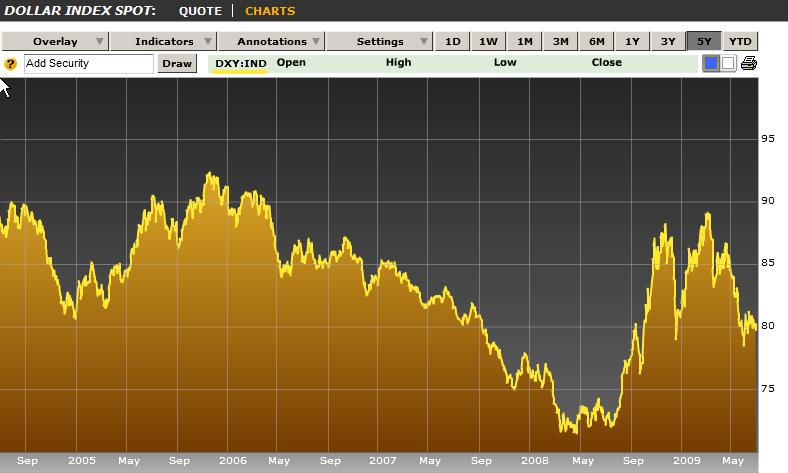
This week brought a couple small developments on this front. First, China released its annual report on the economy, in which it renewed calls for a “supra-national” currency, to be administered by the IMF: “To avoid the inherent deficiencies of using sovereign currencies for reserves, there’s a need to create an international reserve currency that’s de-linked from sovereign nations.” Analysts caution however that the move is politically motivated, and it could be a while before it’s squared with economic reality: “There may be signs here of tensions between the PBOC’s economic concerns over China’s holdings of dollars and the Chinese government’s diplomatic reasons for doing so.”
Still, China is walking the walk. Having already entered into swap agreements with Argentina and several other developing countries, it is moving to conduct as much of its trade in Chinese Yuan as possible. This week, it inked a deal with Brazil, “for the gradual elimination of the US dollar in bilateral trade operations which in 2009 are estimated to reach US$ 40 billion.” Previously, such trade had been settled primarily in Dollars, a bane for Brazilian companies, which collectively “have lost hundreds of millions over the last two years due to dollar weakness”
There is also activity closer to home. “The government said on April 8 that it will allow Shanghai and four cities in the southern Guangdong province, including Shenzhen and Guangzhou, to settle international trade in yunan.” An agreement with Hong Kong, meanwhile, aims to settle at least half of bilateral trade in Yuan. “Hong Kong Financial Secretary John Tsang said the city will be a ‘testing ground’ for use of the yuan outside mainland China.” If successful, this program could quickly expand to encompass the rest of East Asia ex-Japan.
In the short-term, these baby steps won’t have much of an impact on the Dollar. Besides, most Central Banks remain committed to the Dollar, if only for lack of a viable alternative. “The fed's holding of treasureies on behalf of central banks and institutions from China to Norway rose by $257.2 billion this year, or 15 percent, according to data compiled by Bloomberg. That compares with an increase of $127.3 billion, or 10 percent, in the first half of 2008.”
Even China has stated that its reserve policy will not feature any sudden changes. In sum, “It seems safe to say that the Chinese are pursuing a rather logic path. They will continue to accumulate dollar reserves, as doing so fits their three-adjective criteria [liquidity, safety and returns], while also pushing for international acceptance of an alternative to the dollar in a new global currency.”
Subscribe to:
Comments (Atom)